ST EDMUND THE KING, NORTHWOOD HILLS
I have been organist at the Church of St Edmund the King, Northwood Hills since 2000 and for the past few years have also been Director of Music, with a current choir of nine loyal members. For over fifteen years I wrote a monthly article for the church magazine entitled "From the Console" which also included the month's voluntaries. Sadly increased work commitments meant that I was unable to continue to do this. The entire collection of articles can be found below. The weekly music can be found on "The Orbit", the church's weekly pew sheet, which restarted in September 2021 following a break of eighteen months during the pandemic when it was replaced by an online newsletter which is still running in parallel with the pew sheet and which can be found on the church website. Most Sunday services are streamed live via You Tube and links can also be found on the church website.
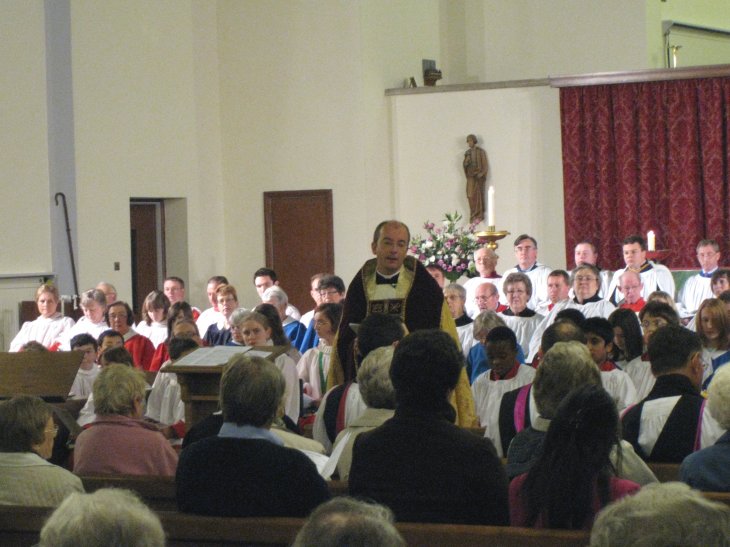
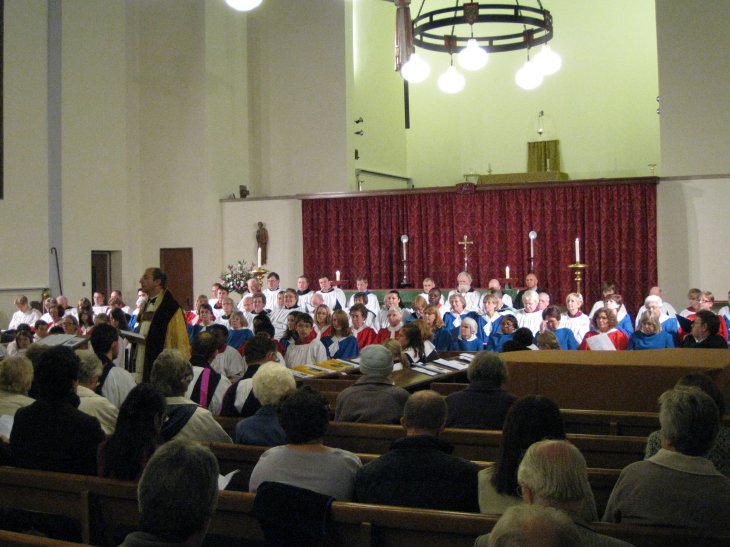
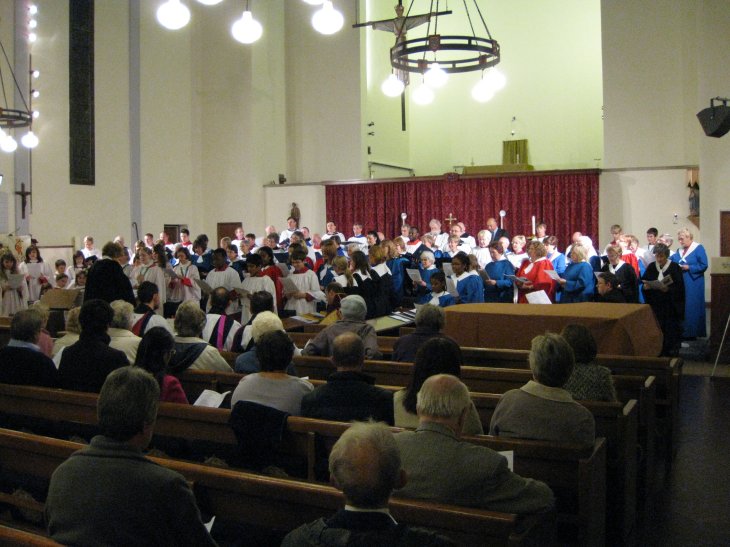
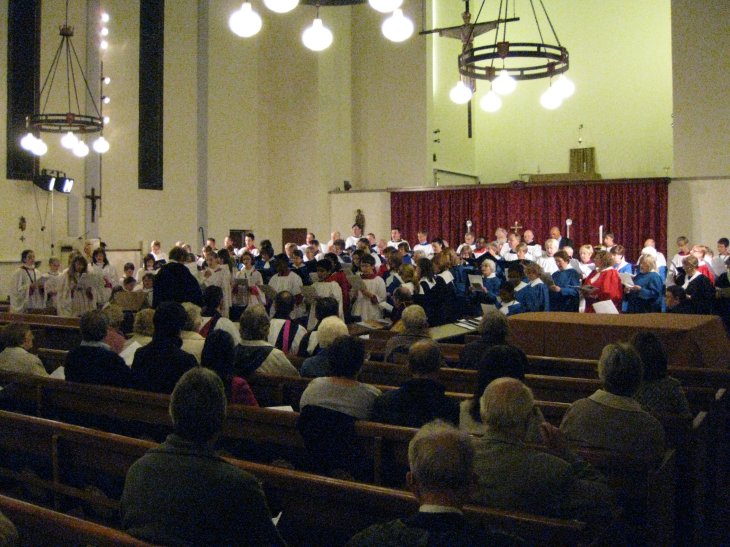
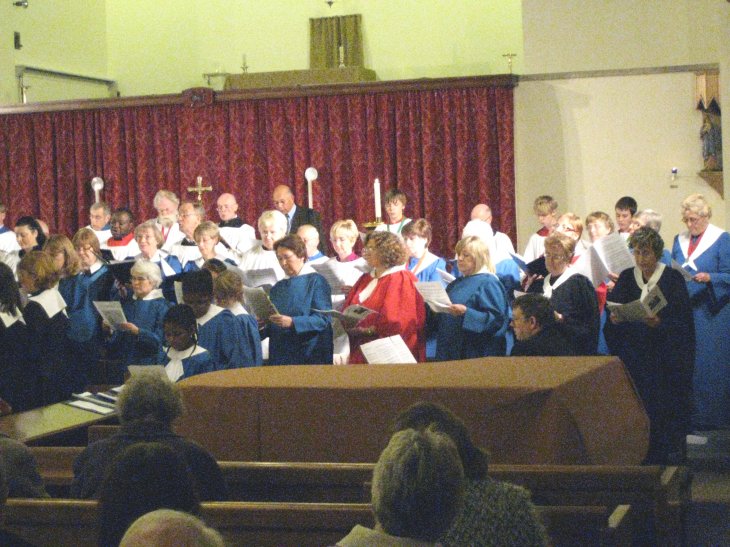
HARROW DEANERY CHOIRS FESTIVAL - OCTOBER 2009
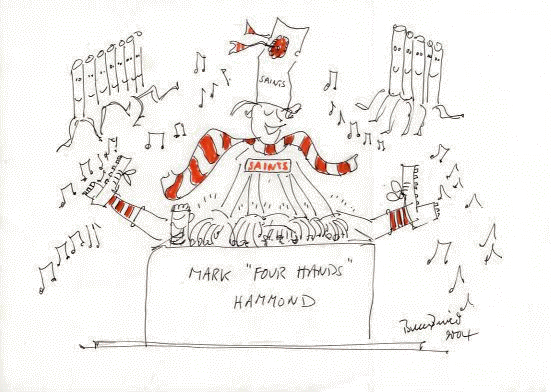
Cartoon by Bruce Driver, former Vicar of St Edmund's
FROM THE CONSOLE - MARCH 2018 - Monthly music list
I am continuing the review of my magazine articles with the year 2012. The full articles are still available online and can be found here.
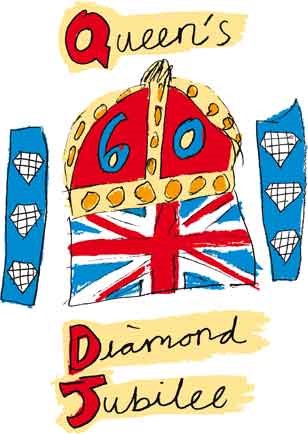
The beginning of June saw the celebration of the Diamond Jubilee of Queen Elizabeth II and St Edmund�s marked the occasion with a banquet on the Saturday evening and a family fun event on the Monday with a barbeque and afternoon tea culminating in a thanksgiving service. Both of my voluntaries � Elgar�s �Nimrod� and Walton�s �Orb and Sceptre� - had been performed at the Queen�s Coronation in 1953 as had Vaughan William�s arrangement of the hymn �All People that on Earth do dwell�, while several of the other pieces had royal connections. After Sunday�s Sung Eucharist service, we travelled into London to experience the Thames River Pageant and even though our view of the river was rather restricted we were glad that we went as the atmosphere was terrific. Other celebratory events included a concert held in front of Buckingham Palace and a service of thanksgiving at St Paul�s Cathedral.
I wrote about several composers celebrating anniversaries during 2012 � John Stanley (b.1712), Frederick Delius (b.1862) and Leon Boellmann (b.1862) � and I shall be performing works by all three during March.
In January I wrote about Eastcote Choral Society and the concert I played for the previous month which featured as its main work Geoffrey Bush�s �Christmas Cantata�. I perform with the Society � since last year renamed the Eastcote and Ruislip Choral Society � on a regular basis and will be once again accompanying them at St Edmund�s on Saturday March 10th in a performance of Rossini�s Petite Messe Solennelle. In March, together with flautist Michael Wood, I gave a Classic Concert featuring Spanish and Latin American music.
There was the second of two layman�s guides to the organ when I spoke about the two different colours of speaking stops (the illuminated buttons on either side of the three manuals) which correspond to the two types of organ pipe. The white stops are called flues. These pipes have no moving parts and produce their sound through the vibration of air molecules in the same way as a flute. The red stops are called reeds and these pipes incorporate vibrating brass strips and are used for oboe, clarinet and trumpet stops. The green stops (known as non-speaking) are couplers which enable the performer to play the stops from one manual on another and this combining allows every stop of the organ to be played simultaneously on one manual.
Our travels included a one-night pre-Christmas stay in Manchester where we visited the Christmas Market as well as the Cathedral and Manchester United�s impressive stadium. I also wrote about several of the places in Provence and the Ardeche where we stayed during the Summer.
2012 was also Olympic year and in July in honour of London hosting the event I performed Spiro Samara�s �Olympic Hymn�, written for the first modern Olympics in Athens in 1896 and declared the official games anthem in 1958. It has been used at all ceremonies since. Unfortunately we were unsuccessful in getting Olympic tickets but managed to attend several of the Paralympics events later in the year, including blind football!
On April 22nd at 3.00pm I will be giving a piano and organ recital as part of the Classic Concert series where I will be featuring music by anniversary composers Charles Gounod (b.1818), Claude Debussy (d.1918) and Leonard Bernstein (b.1918). I am also giving a lunchtime organ recital the previous Saturday April 14th at St Andrew�s Methodist Church in Bushey Heath at 12 noon.
Mar 4th - Weekly pew sheet - "The Orbit"
Prelude - Priere a Notre Dame � L.Boellmann
Postlude � Toccata � L.Boellmann
Mar 11th - Weekly pew sheet - "The Orbit"
Prelude � On hearing the first cuckoo in spring � F.Delius
Postlude � Trumpet Tune � J.Stanley
Mar 18th - Weekly pew sheet - "The Orbit"
Prelude � Herzlich Thut Mich Verlangen - J.Brahms
Postlude � O Mensch, Bewein Dein Sunde Gross - J.S.Bach
Mar 25th - Weekly pew sheet - "The Orbit"
Postlude � Prelude & Fugue No 8 � J.S.Bach
Thu Mar 29th � Maundy Thursday
Postlude � Picardy � E.Thiman
Sat Mar 31st � Holy Saturday
Postlude � Toccata � C.Widor
FROM THE CONSOLE - FEBRUARY 2018 - Monthly music list

I am continuing the review of my magazine articles with the year 2011. The full articles are still available online and can be found here.
In the January issue, I wrote about a concert I had played for the previous November given by the City of Leicester Singers in the church of St James the Greater in Leicester. Elma Orgill, who sings with COLS, is a former St Edmund's churchwarden and also sang alto in the choir. The concert consisted of music by Vivaldi (Gloria), Haydn (Te Deum) and Hummel (Mass).
Anniversaries celebrated during the year included Jehan Alain (b1911), Liszt (b1811), Boyce (b1711), Guilmant (d1911) and Grainger (d1961). The last four were featured in my May recital as part of the Classic Concert series at St Edmund�s. At that concert I was joined by my brother who played several pieces on the trumpet. It was Richard�s first major engagement since his change of career from professional trumpeter to train driver and I was pleased to see that his performing skills had not deserted him! I was also delighted that my Mother and Aunt were able to travel up from Hampshire for the concert and it was a real family occasion as nine of us sat around the table for an excellent tea in the hall afterwards.
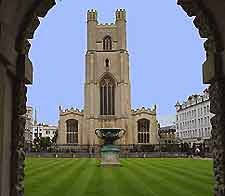
At the beginning of March I attended a memorial concert in Great St Mary�s in Cambridge (pictured) given in honour of my former organ teacher David Sanger who had died the previous May. Great St Mary�s is the University church and all undergraduates must live within a three miles radius of the building. It is unusual in having two self-contained organs, the chancel organ which is used for normal parish worship while the west gallery houses the university organ which is used for formal university services. The participants of the memorial concert read like a who�s who of the organ world. There were performances by current cathedral organists and sub-organists while I was one of a choir of thirty two of David�s friends, family, colleagues and students who performed two of his choral compositions. One of these was written for two organs and it was interesting to hear the spatial effect which this created in the building. The concert was a moving occasion and I was glad to have participated in an event dedicated to a man who taught me a great deal during my three years at Cambridge and who successfully guided me through my Fellowship of the Royal College of Organists.
In the Summer we spent three nights in the Dr�me, a picturesque region to the South-East of Lyon. One of the highlights was a visit to the mediaeval village of Saint Antoine l�Abbeye, officially designated as one of the most beautiful in France. It is perfectly preserved with its labyrinth of narrow winding streets. The Gothic style Abbey was erected between the 12th and 15th centuries and was an important stopping off point on one of the four main routes through France for pilgrims travelling to Santiago de Compostela, where the relics of St James are believed to lie.
In November there was the first of two layman�s guides to the organ where I wrote about the various keyboards or manuals. The most important is the Great Organ, the middle keyboard at St Edmund�s, which has the principal foundation stops (an individual rank of pipes which are selected by pressing one of the white or red coloured buttons). The manual above the great is the Swell Organ, which contains softer stops suitable for choral accompaniment. These are enclosed in a box with shutters which can be opened and closed with a balanced foot pedal to create crescendos and diminuendos. The manual below the great is the Choir Organ, which contains several solo instruments such as flute, trumpet and clarinet. Fourth and subsequent manuals are always located above the swell. The Pedal Organ is operated by the feet and provides the lowest bass notes.
Feb 4th - Weekly pew sheet - "The Orbit"
Prelude - Ave Maria � F.Schubert
Postlude � Prelude & Fugue No 4 � J.S.Bach
Feb 11th - Weekly pew sheet - "The Orbit"
Prelude � Adagio for Strings � S.Barber
Postlude � Prelude & Fugue No 5 � J.S.Bach
Feb 18th - Weekly pew sheet - "The Orbit"
Prelude � Adagio (Symphonie No 3) � C.Saint-Saens
Postlude � Prelude & Fugue No 6 � J.S.Bach
Feb 25th - Weekly pew sheet - "The Orbit"
Prelude � Ave Maria � G.Caccini
Postlude � Prelude & Fugue No 7 � J.S.Bach
FROM THE CONSOLE - JANUARY 2018 - Monthly music list
Jan 7th - Weekly pew sheet - "The Orbit"
Prelude - The Three Kings - P.Cornelius, arr.Hammond
Postlude � Wie Schoen Leuchtet Der Morgenstern � J.S.Bach
Jan 14th - Weekly pew sheet - "The Orbit"
Prelude � Chorale Prelude on �Dix� � M.Archer
Postlude � Prelude & Fugue No 1 in C - J.S.Bach
Jan 21st - Weekly pew sheet - "The Orbit"
Prelude � Chorale Prelude on �Stuttgart� � F.Peeters
Postlude � Prelude & Fugue No 2 in Dm - J.S.Bach
Jan 28th - Weekly pew sheet - "The Orbit"
Prelude � Pavane - M.Ravel
Postlude � Prelude & Fugue No 3 in Em - J.S.Bach
FROM THE CONSOLE - DECEMBER 2018 - Monthly music list

One of my favourite carols and one which we are planning to perform at this year�s carol service is Peter Warlock�s �Bethlehem Down�. Warlock was born Philip Heseltine in London�s Savoy Hotel in 1894 and educated at Eton College. He had little formal training but developed a love of the music of Delius, who was to be a great influence on his own compositions. He was also a close friend of the writer D.H.Lawrence and his pseudonym reflected his interest in the occult. Running short of money, he entered the Daily Telegraph�s annual carol-writing competition in 1927 with Bruce Blunt�s poem "Bethlehem Down":
"When He is King we will give him the King's gifts, Myrrh for its sweetness, and gold for a crown,
Beautiful robes," said the young girl to Joseph, Fair with her first-born on Bethlehem Down.
Bethlehem Down is full of the starlight, Winds for the spices, and stars for the gold,
Mary for sleep, and for lullaby music, Songs of a shepherd by Bethlehem fold.
When He is King they will clothe him in grave-sheets, Myrrh for embalming, and wood for a crown,
He that lies now in the white arms of Mary, Sleeping so lightly on Bethlehem Down.
Here He has peace and a short while for dreaming, Close huddled oxen to keep him from cold,
Mary for love, and for lullaby music, Songs of a shepherd by Bethlehem fold.
They subsequently won the competition and apparently used the winnings to finance an "immoral carouse". Sadly he suffered bouts of depression and in 1930 killed himself by gas poisoning in his Chelsea flat at the age of just 36
In 2011, the art critic Brian Sewell published his memoirs in which he claimed that he was Heseltine's illegitimate son, born in July 1931, seven months after the composer's death. Sewell's mother, unnamed, was an intermittent girlfriend, a Roman Catholic who refused Heseltine's offer to pay for an abortion and subsequently blamed herself for his death. Sewell was unaware of his father's identity until 1986.
As well as �Bethlehem Down�, Warlock has written several other beautiful Christmas carols. You can listen to a selection of these � as well as �Bethlehem Down� itself - via the links below. May I take this opportunity to wish you a Blessed Christmas and my best wishes for 2018.
Bethlehem Down
I saw a fair maiden
Bululalow
Adam Lay Ybounden
Dec 3rd - Weekly pew sheet - "The Orbit"
Prelude � O Come O Come Emmanuel � C.Hand
Postlude � Wachet auf ruft uns die stimme - J.S.Bach
Dec 10th - Weekly pew sheet - "The Orbit"
Prelude � Berceuse (Peterhouse Chapel Windows Suite) � B.Ferguson
Postlude � Nun Komm, Der Heiden Heiland � J.S.Bach
Dec 17th � 10am - Weekly pew sheet - "The Orbit"
Prelude � Gottes Sohn Ist Kommen � J.S.Bach
Postlude � Vom Himmel Hoch � J.Pachelbel
Dec 17th � 6.30pm
Prelude � Six Interludes on Christmas Carols � W.Lloyd Webber
Postlude � In Dulci Jubilo � J.S.Bach & Carillon Sortie � H.Mulet
Dec 24th - Weekly pew sheet - "The Orbit"
Dec 31st - Weekly pew sheet - "The Orbit"
FROM THE CONSOLE - NOVEMBER 2018 - Monthly music list

On Saturday October 14th, St Edmund�s choir travelled to St Andrew�s Church in Roxbourne for the annual Deanery Choirs� Festival with music and readings inspired by The Creation. The history of the church is not dissimilar to that of St Edmund�s. It had its origins in a Mission Hall which was declared a Mission Church in 1941. A young priest rejuvenated the congregation after the Second World War and money was collected to build a new Parish church. 600 local families pledged money to the church building fund and the church itself was opened in 1957. Its spire with its cross is the landmark of the parish. The church is celebrating its diamond jubilee this year with a number of special events.
Alan Ridout was born in South-East London in 1934. At the age of just fifteen he went to study full-time, firstly at the Guildhall School of Music and then two years later at the Royal College of Music, where his composition teachers included Gordon Jacob and Herbert Howells. Much of his life was taken up with teaching; he was Professor of Theory and Composition at the Royal College of Music and also taught at Cambridge, Birmingham and London Universities. He developed a close relationship with Canterbury Cathedral and for a time was on the music staff at the King�s School. His anthem �Let us with a gladsome mind� was published in 1969 and is based on the hymn tune with words by John Milton paraphrasing Psalm 136. Ridout died in Caen, France in 1996 at the age of 62.
Herbert Sumsion was born in Gloucester in 1899. He joined the cathedral choir at the age of nine. Following a spell on active service during the First World War, he became firstly Assistant Organist (1919-1922) and then Organist (1928-1957) at Gloucester Cathedral. One of Sumsion�s first jobs was to conduct the famous Three Choirs Festival, and his impressive performance led Sir Edward Elgar to quip "What at the beginning of the week was assumption has now become a certainty!�. He was also Director of Music at Cheltenham Ladies College for over thirty years. His setting of the Benedicite Omnia Opera (O all ye works of the Lord bless ye the Lord) � a canticle used in Morning Prayer � was published in 1955. Sumsion died in 1995 at the age of 94.
John Rutter was born in London in 1945 and for the first decade of his life lived above a pub opposite Baker Street station. He read music at Clare College, Cambridge and later returned there as Director of Music, a post he held for four years until he decided to devote his time to composition. Rutter is married to Joanne, an American woman he met at a coral workshop in California. They had two sons but tragically the elder, Christopher, was killed in a road accident in 2001 at the age of just nineteen while a student at Cambridge. He has a cottage five miles from his Cambridge home where he goes to compose. �For the beauty of the earth� was published in 1980 to words by the nineteenth century hymnist and poet Folliott Pierpoint which he wrote in 1864 at the age of 29.
The spiritual Deep River was first mentioned in print in 1876 and by 1917, when Henry Burleigh made his influential arrangement, it had become very popular. It appeared in a 1929 film version of �Show Boat� and Paul Robeson performed the song in the 1940 film �The Proud Valley�. It has been performed by Barbra Streisand, Johnny Mathis and Bobby Womack, while Chevvy Chase sang it in the 1983 film �National Lampoon�s Vacation�. It was also one of the four negro spirituals in Sir Michael Tippett�s �A Child of our Time�. John Barnard � whose arrangement we performed - was a pupil and later a modern languages teacher at The John Lyon School in Harrow who is probably best known for his hymn tune �Guiting Power� (Christ Triumphant, Ever Reigning).
�Achieved is the glorious work� is the final chorus in Franz Josef Haydn�s oratorio �Die Schopfung� (�The Creation�) written in 1798 and first performed in Vienna, which depicts and celebrates the creation of the world as described in the book of Genesis, although it also features words from the Psalms and Milton�s �Paradise Lost�. Haydn was inspired to write a large oratorio during his visits to England when he heard oratorios of George Frideric Handel. The oratorio is structured in three parts. The first deals with the creation of light, of heaven and earth, of the sun and moon, of the land and water, and of plants. The second treats the creation of the animals, and of man and woman. The final part describes Adam and Eve during their happy time in the Garden of Eden.
Among the hymns being sung are �For the fruits of his creation� with music by Francis Jackson. Organist and composer Jackson has recently celebrated his 100th birthday. Born in Yorkshire, he was a chorister at York Minster under Sir Edward Bairstow (whose communion service we recently introduced at St Edmund�s) and was organist there from 1946 until his retirement thirty six years later. His communion setting in G is sometimes performed at St Edmund�s. Jackson�s tune �East Acklam� was written in 1957 and named after the hamlet northeast of York where he lives.
Nov 5th - Weekly pew sheet - "The Orbit"
Prelude � Lyric Melody � C.Armstrong Gibbs
Postlude � Prelude in F Minor � J.S.Bach
Nov 12th - Weekly pew sheet - "The Orbit"
Prelude � Nimrod � E.Elgar
Postlude � Fame and Glory � A.Matt
Nov 19th - Weekly pew sheet - "The Orbit"
Prelude � Aria � F.Peeters
Postlude � Prelude in A Minor � J.S.Bach
Nov 26th - Weekly pew sheet - "The Orbit"
Prelude � Prelude to Act 1 (�Lohengrin�) � R.Wagner
Postlude � Crown Imperial � W.Walton
FROM THE CONSOLE - OCTOBER 2018 - Monthly music list


I am continuing the review of my magazine articles over the past fifteen years with the year 2010. The full articles are still available online and can be found here.
During the Summer St Edmund�s hosted a flower festival and in my August column I wrote about my �Flower Hour� organ recital. I included a number of floral-inspired pieces: Tchaikovsky�s �Waltz of the Flowers�, Lemare�s �Andantino in D Flat� (aka �Moonlight and Roses�), Delibe�s �Flower Duet� (famously used in a British Airways advertisement), MacDowell�s �To a wild rose�, Strauss�s �Roses from the South� and Rodgers and Hammerstein�s �Eidelweiss�.
In February I wrote about the visit to St Edmund�s by the Organ Club, who arrange monthly visits to interesting instruments. I performed a short programme of French music by Louis Vierne (�Legende�) and Henri Mulet (�Carillon Sortie�) to an audience of over forty, after which club members had the opportunity to play the organ. I also gave a short presentation on the history of the church and the organ.
In the Autumn I wrote about two places of interest visited en route to and from our summer trip to the South of France. Reims is a two and a half hour drive South East of Calais and is rather confusingly pronounced rance rather than reems. It was a major Roman city and the Cathedral was the traditional site of the coronations of the Kings of France. Reims is also the centre of the Champagne region and boasts the impressive headquarters of a number of grandes marques including Mumm and Pommery, which we saw during an interesting open top bus tour of the city. On my return journey I stopped over in Paris and visited the church of La Madelaine (pictured above). The current building, based on the Roman Maison Carr�e in Nimes and originally designed as a temple to glorify Napoleon's armies, was consecrated as a church in 1842. The organ was constructed by the famous French builder Aristide Cavaill�-Coll in 1846 and was his first to consist of four separate manuals. In 1849, the funeral of Frederick Chopin took place there with Louis Lef�bure-Wely at the organ. Between 1895 and 1906, Gabriel Faur� held the post of organist, although he was assistant there for the previous twenty years.
In September I wrote about the forthcoming beatification of cleric and poet Cardinal John Henry Newman by Pope Benedict XVI at an open air mass in Cofton Park in Birmingham, Newman's adopted home and final resting place, during the Pontiff's four-day visit. His most famous poem, "The Dream of Gerontius", concerns the prayer of a dying man and his soul's subsequent journey towards judgement and purgatory. In 1900, Edward Elgar used the poem for his oratorio which was first performed in Birmingham Town Hall. The poem includes the hymns "Praise to the Holiest in the Height" and "Firmly I Believe and Truly". He also wrote the hymn "Lead Kindly Light" during a voyage from Sicily to Marseille following a serious illness.
Anniversaries celebrated during the year included the bicentenary of the births of Robert Schumann and Samuel Sebastian Wesley (b1810) as well the centenary of the birth of Samuel Barber (b1910).
Oct 1st- Weekly pew sheet - "The Orbit"
Prelude � Andantino in D Flat � E.Lemare
Postlude � Fugue No 1 on BACH � R.Schumann
Oct 8th- Weekly pew sheet - "The Orbit"
Prelude � To a wild rose � E.MacDowell
Postlude � Processional � W.Mathias
Oct 15th- Weekly pew sheet - "The Orbit"
Prelude � Legende � L.Vierne
Postlude � Carillon Sortie � H.Mulet
Oct 22nd- Weekly pew sheet - "The Orbit"
Prelude � Pavane � G.Faure
Postlude - Chorale Prelude on �Praise the Lord O my soul� � S.Karg-Elert
Oct 29th- Weekly pew sheet - "The Orbit"
Prelude � Prelude (�The Dream of Gerontius�) � E.Elgar
Postlude � Chorale Prelude on �Nun Danket� � S.Karg-Elert
FROM THE CONSOLE - SEPTEMBER 2017 - Monthly music list
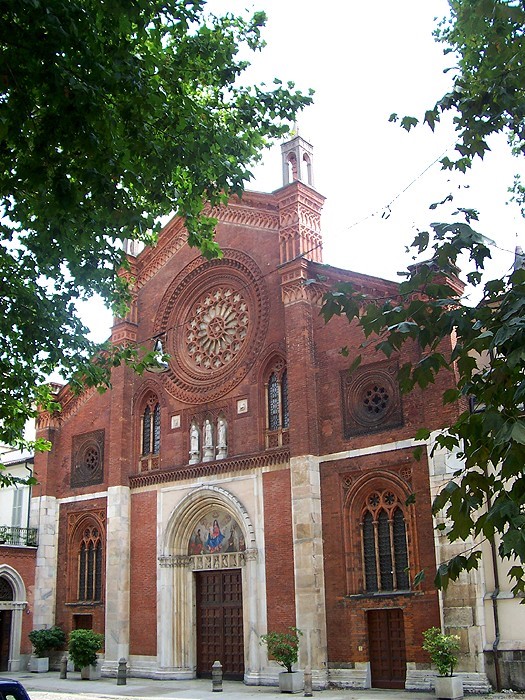
During the summer we spent a couple of days in Milan. We visited a number of beautiful churches in the city including San Marco. This church, the second biggest in Milan after the Cathedral, dates from the 13th century and according to tradition was dedicated to St. Mark, patron of Venice, after the help given by that city in the war against Emperor Frederick I. The building underwent considerable expansion in the 17th Century and a new fa�ade was added in the 19th Century.
In 1770 the fourteen year old Mozart, together with his Father, visited Milan for two months, the first of five visits the composer was to make in his lifetime. They staying in the monastery at San Marco, composing, performing and receiving a commission for an opera, the first of three he wrote for Milan.
The church was also the venue for the first performance of Giuseppe Verdi�s �Requiem�. It was written in 1874 in honour of the Italian poet and novelist Alessandro Manzoni who the composer admired who had died the previous year and whose funeral had been in San Marco. Verdi himself conducted the first performance on the first anniversary of the writer�s death and it was repeated three days later in La Scala.
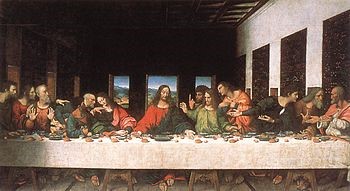
The highlight of the trip was undoubtedly visiting Leonardo Da Vinci�s �Last Supper�. This mural occupies one end of the refectory of the Convent of Santa Maria della Grazie, although sadly very little of the original painting remains. The work is thought to have been started around 1495 and took around three years to complete, although Da Vinci was not working on it continuously. It was a commission by the Duke of Milan as part of a series of renovations to the church and convent. Because of the medium and type of wall used, the painting deteriorated fairly quickly. It has undergone a number of restorations � the last being in 1999 - and has been deliberately damaged several times. Before entering the refectory, we had to pass through several acclimatisation chambers as the humidity in the room is greatly reduced to minimise damage. The mural shows the reaction of each apostle when Jesus says that one of them will betray him. There are a number of references to the number three, representing the Holy Trinity. The apostles are grouped in threes, there are three windows in the background and the shape of Jesus resembles a triangle.
Sep 3rd - Weekly pew sheet - "The Orbit"
Prelude - Canon in D � J.Pachelbel
Postlude � Voluntary No 10 � W.Boyce
Sep 10th - Weekly pew sheet - "The Orbit"
Prelude � Apres un reve � G.Faure
Postlude � Grand March (�Aida�) � G.Verdi
Sep 17th - Weekly pew sheet - "The Orbit"
Prelude � Pavane pour une infant defunte � M.Ravel
Postlude � Toccata � G.Mushel
Sep 24th - Weekly pew sheet - "The Orbit"
Prelude � Air on the G String � J.S.Bach
Postlude � Sortie in E Flat � L.Lefebure-Wely
CLICK HERE FOR SEPTEMBER 2016 - AUGUST 2017 COLUMNS
(Column Review 2006 - Review 2007 - Harrow Deanery Choirs' Festival in Stanmore - This year's St Ed's carols - Review 2008 - A Dijon stopover - St George's Day Classic Concert - Review 2009 - Choral Evensong at St Ed's)
CLICK HERE FOR SEPTEMBER 2015 - AUGUST 2016 COLUMNS
(Lourdes - Harrow Deanery Choirs' Festival at St Ed's - Harrow on the Hill - David Willcocks - John Rutter & Father Philip's last service - Column Review 2002 - Walsingham - Review 2003 - Review 2004 - Review 2005 - Choral Evensong at St Ed's - Parry's Jerusalem)
CLICK HERE FOR SEPTEMBER 2014 - AUGUST 2015 COLUMNS
(Classic FM Hall of Fame - Mary Magdelene in France - Harold Darke - Songs of Praise Carol Poll - A weekend in St Omer -
Marseille - Education in Winchester - Cambridge - & Durham - Montmartre - Magna Carta Concert - Nantes & Bordeaux)
CLICK HERE FOR SEPTEMBER 2013 - AUGUST 2014 COLUMNS
(Marathon II - Ghent & Antwerp - King's College Carols - Songs of Praise Top Hymns 10-8 - Hymns 7-5 - Hymns 4-2 -
Hymn 1 & RCO Classic Concert - WW1 trip & composers - Bow Church - A Cambridge Wedding)
CLICK HERE FOR SEPTEMBER 2012 - AUGUST 2013 COLUMNS
(Saint-Saens in Paris - Ardeche - Provence - Boellmann - Marathon II - Provencal traditions -
Crux Fidelis - Classic Concert - Verdi & Wagner - Britten - Poulenc & Hindemith)
CLICK HERE FOR SEPTEMBER 2011 - AUGUST 2012 COLUMNS
(Saint Antoine l'Abbeye - Organ on the Internet - Organ Guide 1 - Sans Day Carol - Eastcote CS - Manchester -
Organ Guide 2 & Classic Concert - John Stanley - Frederick Delius - Walton & Elgar - Diamond Jubilee)
CLICK HERE FOR SEPTEMBER 2010 - AUGUST 2011 COLUMNS
(Cardinal Newman - Reims & Maria von Paradis - Paris & Coe Fen - Christmas & David Sanger - City of Leicester Singers - Jehan Alain - Christchurch Priory
Choir at New Milton - David Sanger Memorial Concert - anniversary composers at Classic Concert - Ave Marias - Hubert Parry)
CLICK HERE FOR SEPTEMBER 2009 - AUGUST 2010 COLUMNS
(Felix Mendelssohn - Deanery Festival music - St Cecilia - The Coventry Carol - Samuel Barber - The Organ Club
at St Edmunds - Vierne & Mulet - Bach's Toccata & Fugue - S.S.Wesley - Classic FM's organic Hall of Fame - Robert Schumann -
St Edmund's Flower Festival)
CLICK HERE FOR SEPTEMBER 2008 - AUGUST 2009 COLUMNS
(Organ Marathon - Olivier Messiaen - Ralph Vaughan Williams - Christmases past - St Thomas' Church Strasbourg -
Bach's organ works - John Newton & Amazing Grace - Music in the Netherlands - Henry Purcell - George Frederick Handel - Joseph
Haydn & a canal bike ride)
CLICK HERE FOR SEPTEMBER 2007 - AUGUST 2008 COLUMNS
(Edward Grieg - Francois Couperin - My Christmas Top 10 - Music at Father Bruce's final service - John Merbecke -
Gregorio Allegri - Hubert Parry & Percy Whitlock - Portraits of Bach & Mozart - Organ Marathon - More Organ Marathon - Classic
FM Hall of Fame)
CLICK HERE FOR SEPTEMBER 2006 - AUGUST 2007 COLUMNS
(Hymns 11 & 10 - Hymns 9 & 8 - Hymns 7 & 6 - Christmas in France - Hymns 5 & 4 - Hymns 3 & 2 - Hymn 1 - Bach's
Toccata & Fugue - Peterhouse Chapel Window Suite & Edward Elgar - Saint Antonio in Lisbon)
CLICK HERE FOR SEPTEMBER 2005 - AUGUST 2006 COLUMNS
(Sydney Carter - A trip to Rouen - John Newton & Amazing Grace - King Wenceslas - Crossword - Giulio Caccini & crossword
solution - Songs of Praise Top 20 Hymns 20-18, Hymns 17 & 16, Hymns 15 & 14, Hymns 13 & 12)
CLICK HERE FOR SEPTEMBER 2004 - AUGUST 2005 COLUMNS
(William Boyce - La Trinite & St Clothilde in Paris - Edward Elgar - Peter Warlock's Bethlehem Down - Crossword
- Crossword solution - A concert in Greenwich - Concerts in Edinburgh & York - St Margaret's choir tour - Queen Margaret
of Scotland - A trip to Barcelona)
CLICK HERE FOR SEPTEMBER 2003 - AUGUST 2004 COLUMNS
(Churches in France - Vaughan Williams & Organ Guide 1 - Concert From Advent to Trinity - Classic FM's
favourite carol - Crossword - Crossword solution - Henry Smart & Organ Guide 2 - George Frederick Handel - Charles Stanford -
St Sulpice in Paris - St Vicent de Paul & Boellmann)
CLICK HERE FOR SEPTEMBER 2002 - AUGUST 2003 COLUMNS
(Pachelbel's Canon - St Ed's Organ & Herbert Howells - St Ed's Organ 2 William Matthias - J.S.Bach & In Dulci
Jubilo - Albinoni - Maria von Paradis - Christchurch Priory - Winchester Cathedral - Peterhouse Cambridge - Durham University -
St Mary's Southampton)